THROUGH THE STORM
How We Stand in a Fractured Era
“Liberty, once lost, is lost forever.”
~ John Adams
Help get this book published.
Please participate in the 2 Minute Reader Poll at the bottom of this page.
How did we COME TO FACING THIS CRISIS?
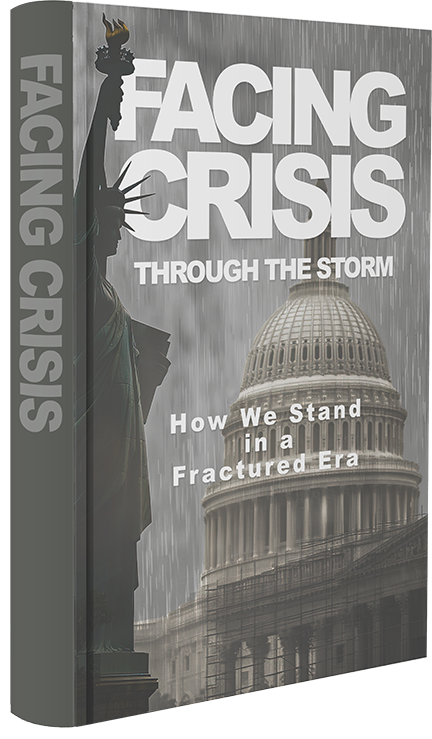
This book began with that one simple question and my growing cynicism about government leadership over the past twenty years.
I’ve become skeptical of the explanations—excuses, blame, and lies that are often given. I wanted to understand what is really happening.
What once could be dismissed as exaggeration, propaganda, or political rhetoric can no longer be so easily excused.
Political and social divide, economic instability, institutional strain, and war are now visible features of daily life.
My questions led me down a long path of discovery. They answers challenged, and changed much of what I’ve been taught to believe about politics, power and world events.
My goal is to simply share what I’ve learned. I do not intend to persuade you politically or push any ideology.
I’m just presenting ideas that may help you make sense of your own observations and decisions.
I write this from within the storm, not outside it. I belong to a generation living through institutional fracture while raising children who must rebuild what they did not break, and watching grandchildren grow up in conditions they did not choose.
You may belong to later or more recent generations. No matter your place in this crisis this book will help orient where you stand and what remains within your control.
HOW DO WE MOVE THROUGH THE STORM?
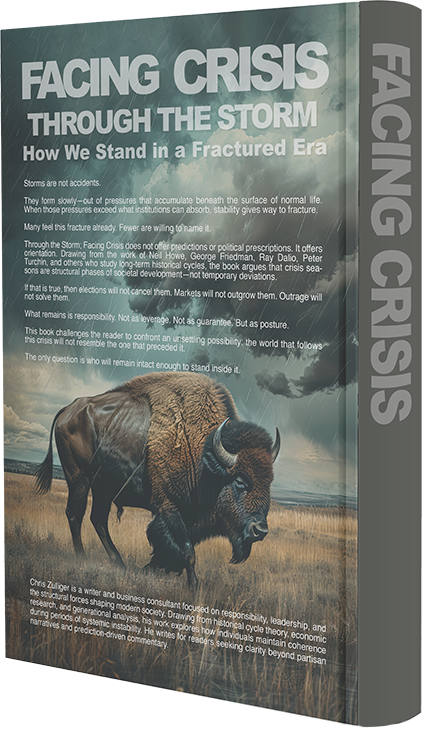
This book challenges the reader to question what they believe and to confront an unsettling possibility: The world that follows this crisis may not resemble the one that preceded it.
How me move through the storm will determine how we stand in the next season.
“In a fierce prairie storm, cattle often get spooked, turn tail and run from it. Getting divided and lost. But buffalo herd closely together and go into the storm head on, coming out of it faster, stronger and united.”
This book is about understanding the forces and patterns which create crisis seasons and accepting that hard times are a function of growth and renewal.
“The greatest benefit to recognizing patterns is that it gives you a pathway to power, and a ladder out of chaos.” — Tony Robbins
The concepts presented will strip away blame and divisive rhetoric and explore how to live responsibly through the storm. Not with social commentary and rage but by personal examination and proactive engagement.
Most importantly, how our individual and collective actions through the storm will shape the generations that follow.
Are you open to unexpected answers? This book is for you. Read on.
WE SEE AND FEEL THE EFFECTS, BUT What IS THE CAUSE OF THIS CRISIS?
What if economic and social divides are a cause not an effect?
What if elected Presidents are an effect not the cause?
What if personal action influences outcome more than we believe?
What if crisis seasons are a function of renewal not destruction?
What if this moment is part of a recurring pattern?
Excerpt from Chapter 5:
UNDERSTANDING Historical Cycle FrameworkS
“History never repeats itself, but it does often rhyme.” — Mark Twain
History does not move in a straight line. Societies tend to move through recurring seasons.
Long periods of stability allow institutions to grow strong, but they also allow hidden pressures to accumulate. Debt expands. Competition for power increases. Public trust slowly weakens. Eventually those pressures force a period of crisis and restructuring.
Scholars across several fields have described these patterns. Historians, economists, and political scientists use different language, but they often describe the same four broad phases of stability, strain, fragmentation, and crisis. Often referring to storms and seasons.
SYNTHESIZED PHASE RESEARCH TABLE
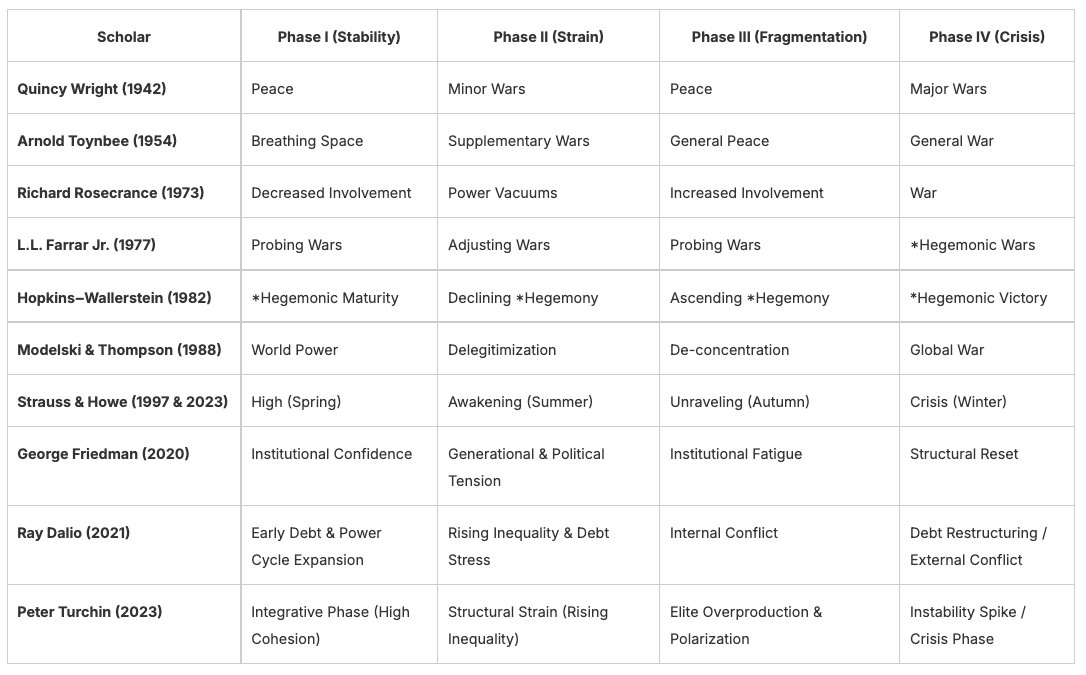
*Hegemony is the dominance of one group, state, or culture over others, characterized by a mix of coercion and, crucially, consent through shared, often unquestioned, ideologies.
*Hegemonic war is a total, system-wide conflict between major powers that determines the leadership and structural organization of the international order.
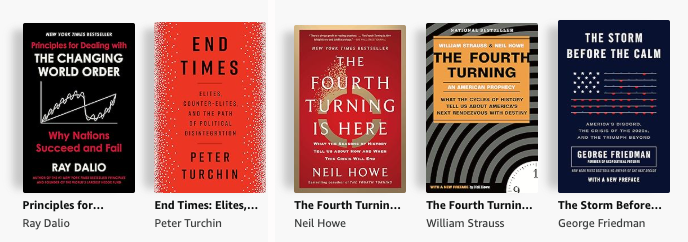
books used in researcH and the table BELOW
Why Leaders Don’t Stop THE FRACTURE
History suggests that in fractured eras, leaders do not rescue societies from the storm. They are chosen by societies already in it. The decisive variable is not who holds office—but how citizens adapt, endure, and take responsibility for what remains within their control.
“Never let a good crisis go to waste.”
As we are quickly learning, our chosen leaders—no matter the party, often take advantage of crises to move agendas forward. And seldom deliver meaningful solutions to The People.
Waiting idly for the next election isn’t a winning strategy — proactive personal engagement , planning, and decisive action are what lead to real progress and desired outcomes.
Personally, professionally, and as a society, we have an opportunity to use this season to our advantage.
SUMMARY OF CONTENTS
PART I — ORIENTATION: UNDERSTANDING THE STORM
PART II — PATTERNS: HOW SOCIETAL CRISIS FORMS
PART III — POSITION: WHERE YOU STAND
PART IV — RESPONSIBILITY: WHAT STILL MATTERS
PART V — ENDURING: HOW TO LIVE INSIDE THE CRISIS
PART VI — WHAT COMES NEXT (WITHOUT PREDICTION)
APPENDICES: (Printable)
Systems Analysis and Strengthening - Personal, Family, Professional
Rules of Life Through the Storm
Leaders’ Storm Checklist
Generational Reference Chart
Crisis seasons are not new. They are not random.
And they are not automatically catastrophic.
The cycles of history show that what follows depends in part on how a society responds.
We have a responsibility to future generations to do everything in our power to preserve Liberty.
There is still time
2 Minute READER POLL
This is not a mailing list sign-up.
It is a short market test to determine whether this book should move to full publication.
If you were personally invited to review this project, thank you.
If you discovered this publicly, your perspective is equally valuable.